
AI Is Now Buying Products Without Clicking Your Website. Is Your Brand Ready?
7 minutes
Something shifted in how people shop in 2026, and most brands haven't noticed yet.
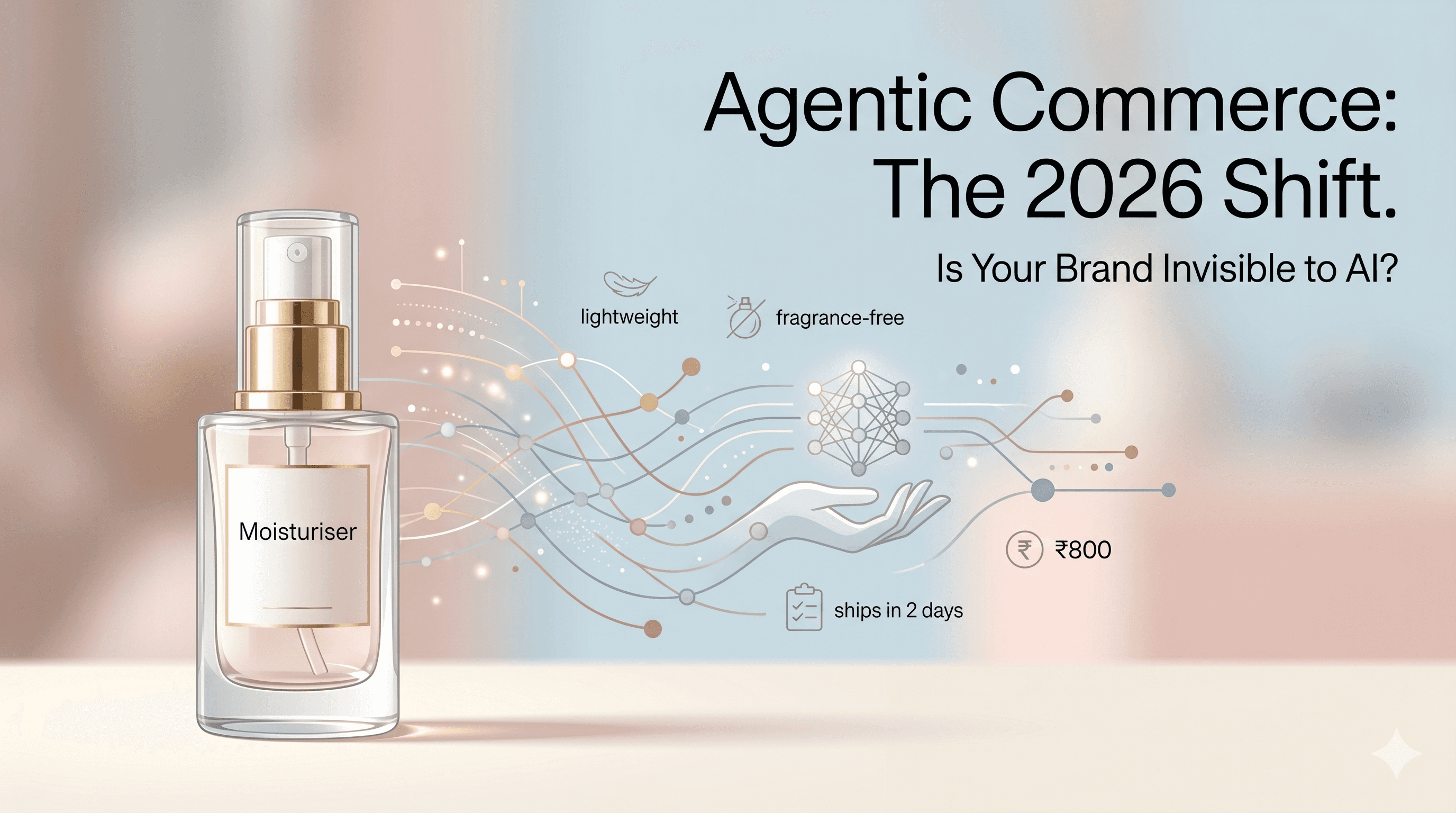
A user opens ChatGPT. Types: "Find me a lightweight moisturiser under ₹800, fragrance-free, ships in 2 days." ChatGPT queries multiple brands, evaluates product data, checks shipping timelines, compares prices, and either completes the purchase directly or presents a ranked shortlist with one-tap checkout.
Your brand either shows up in that result, or it doesn't exist in that transaction.
This is agentic commerce. And it's not coming. Google launched the Universal Commerce Protocol at NRF in January 2026, enabling AI agents to interact with merchant catalogs and complete purchases through a single open standard. ChatGPT, which just hit 900 million weekly active users, has introduced shopping features backed by its Agentic Commerce Protocol. Adobe Digital Insights found that AI-driven visits to US retail sites increased 393% year over year in Q1 2026, and AI-referred shoppers converted 42% better than non-AI visitors in March 2026.
This is the most significant shift in digital commerce since mobile. And the window to get ahead of it is right now.
What Agentic Commerce Actually Is (And Isn't)
Let's be clear about what we're talking about, because the term is getting used loosely.
A chatbot that answers your questions is not agentic commerce. A product recommendation engine is not agentic commerce. Those are tools that assist a human who is still making every decision.
Agentic commerce goes further: an autonomous AI agent handles the entire transaction, from interpreting intent to comparing merchants to completing the purchase and managing delivery, without requiring the human to click through each step.
The human sets the parameters, budget, category, delivery requirement, brand preferences. The agent executes. It queries your product data via APIs, evaluates your pricing and shipping against competitors, checks your return policy programmatically, and either selects your product or routes the purchase elsewhere.
AI agents powered by OpenAI models often act as the first filter in purchasing decisions, evaluating options before users ever see a ranked list. This places the agentic layer upstream of traditional SEO and paid acquisition strategies.
Read that again. Upstream of SEO. Upstream of paid ads. If an agent doesn't surface your product, all your marketing spend becomes irrelevant for that transaction.
The Scale Is Already Real
AI platforms will account for 1.5% of total US retail ecommerce sales in 2026, nearly $20.57 billion, nearly quadruple 2025 figures. McKinsey projects the global agentic commerce opportunity at $3 trillion to $5 trillion by 2030.
A recent study revealed that 73% of consumers are already using AI in their shopping journey, embracing AI assistants for product ideas (45%), summarising reviews (37%), and comparing prices (32%). And 70% are at least somewhat comfortable with an AI agent making purchases on their behalf.
For Indian D2C brands, the numbers are directionally similar, adoption curves in India's digitally native consumer base are moving fast, and the infrastructure is already live. As of March 2026, Shopify's agentic storefronts are available to millions of Shopify users, with products automatically discoverable in ChatGPT for US shoppers, and Copilot and Google available via a simple settings toggle.
The brands that prepare now will capture early-mover advantage in a channel that converts dramatically better than traditional organic. The brands that wait until agentic commerce is "mainstream" will be playing catch-up in a landscape that's already shaped.
The Core Problem: Your Website Was Built for Humans, Not Agents
Here's the uncomfortable truth. The primary interaction in agentic commerce is no longer between a shopper and a website, but between an AI model and structured backend infrastructure. Performance metrics shift accordingly, click-through rate measures human interaction with the page. In agentic commerce, the more relevant metric is the AI citations rate: whether a shopping assistant retrieves, references, or recommends your inventory during fulfilment.
Most brand websites, even well-designed, fast, conversion-optimised ones, are architecturally built for humans browsing and clicking. Agents don't browse. They query. They need:
Structured product data — clean, complete, attribute-rich feeds that an AI can parse without guessing
Real-time inventory APIs — agents evaluate delivery timelines programmatically; if your stock data isn't live and API-accessible, agents can't trust it
Frictionless checkout — humans sometimes tolerate friction. Agents can't. If the user flow is inconsistent, slow, or messy, the agent routes elsewhere
Complete product descriptions — if a brand isn't making detailed information about its products visible to AI search channels, it won't show up in AI recommendations that are driving sales
Schema markup and structured metadata — the technical layer that lets AI systems understand what your product is, who it's for, and why it's relevant to a specific query
Most D2C brand websites are missing at least three of these five. Which means they're already invisible to a growing slice of purchase activity.
Zero-Click Commerce Is the Real Wake-Up Call
Zero-click commerce is set to disrupt retail in 2026 as shoppers may never need to click, search, or visit a website to make a purchase. Retailers that address zero-click commerce can gain loyalty and revenue, while those that resist risk losing visibility to AI platforms that control which products are seen.
This compounds the SEO problem we've been writing about for the past year. First, AI Overviews ate organic traffic by keeping users on Google. Now, agentic commerce means users may complete purchases without ever visiting any website at all.
The implication is stark: the metric of "website traffic" is becoming a less complete picture of your brand's digital performance. A brand that's invisible on its own website analytics but consistently recommended by AI shopping agents is actually winning. A brand with strong traffic but no presence in agentic channels is leaking transactions it doesn't even know exist.
What to Actually Do Right Now
This isn't a 12-month roadmap. Here's what matters immediately:
1. Audit your product data completeness. Go to your product pages. For every SKU, ask: does this have a complete title, detailed description, all relevant attributes (size, material, colour, use case), accurate pricing, and current stock status? Gaps in product data are gaps in agent discoverability. Fix them before anything else.
2. Add structured data / schema markup. For every product page, implement Product schema with offers, availability, reviews, and shipping information. This is the technical layer that lets Google's AI Mode, ChatGPT, and Perplexity understand your products at a machine level. On Framer and most modern platforms, this can be added without a full rebuild.
3. Clean up your checkout flow. Your product data, schema markup, and checkout infrastructure need to be flawless for agentic commerce to route purchases to you directly. Any friction point, slow load, confusing steps, non-standard payment flows, is a reason an agent routes elsewhere.
4. Get on Shopify's Agentic Storefronts or equivalent. Shopify Catalog automatically broadcasts your product data across ChatGPT, Copilot, and Google, with orders flowing into your store's admin dashboard with full channel attribution. If you're on Shopify, this is likely one settings toggle away. Turn it on.
5. Manage your reviews and reputation across third parties. Brands that win in 2026 will have a mechanism in place to ensure critics don't define the narrative of their products. If you're not managing what's being said about you on third parties, reviews, communities, forums, you're letting the ecosystem define you. That has grave implications for your ability to acquire customers via AI search. Agents evaluate review signals. Your average rating and review sentiment is a ranking factor in agentic recommendations.
6. Think about your website as two things simultaneously. Your human-facing website remains the home for your brand's emotional connection, storytelling, and complex browsing experiences. Humans shop with their eyes and their hearts; agents shop with their logic and their data. Your website is for the human; your structured data endpoints are for the agent. You need both, optimised separately.
The Opportunity for Brands That Move First
Shoppers directed to retail sites from AI platforms are 30 times more likely to make a purchase, per Adobe data. Retailers that deployed AI capabilities saw 14.2% sales growth between 2023 and 2024, compared to 6.9% for those without.
The performance gap is real, it's growing, and it's compounding. The brands building agentic readiness now, clean product data, structured metadata, frictionless checkout, active reputation management, are building a structural advantage that will be difficult to close in 12 months.
This isn't about being early for its own sake. It's about the fact that the brands showing up consistently in AI recommendations are building brand recall in a new channel before it becomes crowded. The AI citation rate your brand earns in 2026 shapes how often you show up in 2027, when the volume is 3x higher.
For D2C brands in particular, where margins are often thin, CAC is rising, and every conversion channel matters, agentic commerce is one of the few genuinely new acquisition channels with outsized early-mover returns. The window is open. It won't stay open for long.
At Pgeerated, we build websites and digital foundations that work for the commerce environment of 2026, not 2020. Structured for AI discoverability, fast enough for agents, and still compelling enough for the humans who land on them.
Book your free audit call → https://forms.gle/iXiL8r1prQ6Z5g5F7
We'll map your current funnel, identify your biggest conversion gaps, and give you a clear picture of where to focus first.


