
Snitch ₹900 Cr FY26 Revenue - The Brand Strategy Behind India's Fastest D2C Fashion Brand
5 minutes
Thirty to thirty-five new styles. Every single day.
Not every week. Not every drop cycle. Every. Day.
That's the operational reality inside Snitch, the Bengaluru-born menswear brand that just reported ₹900 crore in FY26 revenue, an 80% jump from ₹498 crore the year before. 115 stores across India. 60% of revenue still online, 40% from offline. A quick commerce arm called Snitch Quick now live in four cities, with Hyderabad and Mumbai next.
And they're targeting ₹1,400 crore in FY27.
Five years ago, Snitch was a B2B fabric supplier that almost went under during the pandemic. The founder had ₹25 lakh worth of fabric and no buyers. What happened next is one of the most interesting brand strategy stories in Indian D2C, and there's a lot more to it than "they moved fast."
The Pivot That Started Everything
When COVID wiped out wholesale demand in 2020, Siddharth Dungarwal made a decision that most founders in his position wouldn't have: instead of waiting for retail to recover, he went directly to the consumer.
Not with a luxury brand play. Not with an influencer-first strategy. With a brutally simple insight: Indian men were becoming more fashion-conscious and nobody was really serving them well.
Where nearly 90% of fast fashion brands in the industry catered to women, Snitch identified a clear market gap. Young men in India's Tier 2 and 3 cities were becoming more fashion-conscious but had few choices available.
One website. Trend-driven designs. And a content strategy that understood Instagram before most fashion brands understood the internet.
During the pandemic, Snitch went from a meagre 70 orders per day to over 1,500 orders per day.
That's not a marketing win. That's a market insight arriving at the exactly right moment, and a brand that was built to move fast enough to capture it.

Speed Is the Brand
Most people who study Snitch focus on the aesthetics, the Gen Z energy, the meme-forward content, the influencer collabs. These matter. But they're not the brand.
The brand is speed.
Snitch's core competitive advantage is a vertically integrated supply chain that allows them to design, produce, and list new products faster than almost any competitor in India. The brand eliminated the middleman and owned the entire supply chain, from design to delivery. The product catalogue is a playground of fashion-forward, expressive, and experimental styles, something Indian men rarely had access to locally.
30-35 new styles per day means 1,000+ new SKUs per month. The customer who checks Snitch on Monday and comes back Thursday sees a genuinely different store. That freshness is addictive, and it's built into the product model, not the marketing.
This is a critical distinction. Most brands try to manufacture freshness through campaigns. Snitch built freshness into operations. The marketing reflects the product reality; it doesn't create an illusion of something that isn't there.
The Data Machine Behind the Drops
None of this would work without aggressive data infrastructure. Snitch isn't guessing what to drop, they're reading what's working in real time.
AI takes away the guessing. The computer looks at what people are searching for on the internet. Snitch uses AI to see what trending men's fashion is hot right now. They never have to guess.
Trend data feeds into design. Design feeds into a rapid production cycle. Production feeds into a daily drop. The daily drop generates sales data. Sales data feeds back into trend identification. The loop runs continuously.
The practical implication: Snitch's dead stock risk is dramatically lower than a traditional fashion brand that designs 3 months in advance and hopes the market agrees. They design 3 weeks in advance based on signals the market is already sending.
For any D2C brand, this principle scales down. You don't need AI to do this at early stage, you need the habit of letting data lead decisions rather than intuition. What's your best-performing product page? What search terms bring the highest-converting traffic? What content format generates the most saves vs. likes? These signals are already telling you what to build next.
Shark Tank Was a Distribution Event, Not a Funding Event
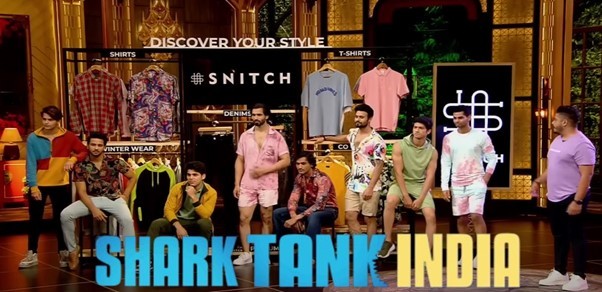
Most people remember Snitch's Shark Tank India Season 2 appearance as a funding story. All five sharks invested. ₹1.5 crore. Great television.
The real value wasn't the money.
Almost overnight, SNITCH transitioned from a known D2C label to a household name, fueled by a relentless focus on its niche as a dedicated men's fashion brand. In less than two years, revenue jumped from ₹120 crore to over ₹400 crore.
National television gave them instant credibility and scale of awareness that would have taken years of marketing spend to build organically. The episode functioned as the largest brand awareness campaign Snitch ever ran, and it cost them 1.5% equity.
The lesson: the best marketing isn't always traditional marketing. Sometimes it's choosing the right stage to tell your story on, and telling it in a way that travels far beyond the original audience.
115 Stores Later, the Online-Offline Balance
Snitch closed FY26 with an operating revenue of ₹900 Cr, up about 80% from ₹498 Cr in the previous fiscal year. The brand is currently generating about 60% of its revenue from online channels, with offline stores contributing the remaining 40%.
This split is instructive. A brand that built its entire early identity online, D2C website, Instagram, performance marketing, is now doing 40% of revenue through physical retail. The stores aren't a pivot away from digital. They're the physical expression of a brand that already built its digital equity.
Snitch currently has 115 stores across India and is looking to further strengthen its presence in East India as part of its domestic expansion strategy.
The quick commerce play, Snitch Quick, is the next frontier. Fast fashion delivered fast. The brand that built its whole identity around speed is now applying that identity to delivery itself. It's a natural extension that existing customers will immediately understand and new customers will find compelling.
What Your Brand Should Actually Learn From Snitch
The easy takeaway from the Snitch story is "be fast and be Gen Z." That misses the point.
The real lessons are structural:
Align your product model with your brand promise. Snitch promises freshness, and the operations deliver it, every day, measurably. Your brand promise needs to be backed by something real in how the product works. Claiming to be "innovative" without a process for innovation is just copywriting.
Use data to lead, not just to track. Most brands use analytics to see what happened. Snitch uses data to decide what to make next. That's a different relationship with information, and it creates a compounding advantage.
Speed matters more than perfection at early stage. Snitch drops 35 styles a day; some will underperform. That's the model. Fast iteration beats slow perfection. The brands that wait until everything is exactly right consistently get overtaken by the brands that ship, learn, and adjust.
Your content strategy should reflect who your customer actually is, not who you wish they were. Snitch's marketing isn't just about showcasing fashion. It's about reflecting cultural energy,, through memes, reels, influencers, and UGC. Instagram-first strategy with 10–15 posts per week, high use of trending audio, creator-led content, and humour. The brand sounds like its customer because that's who the founder understood from the start.
The Question Worth Asking
Your brand has a promise. Does your operation actually deliver it, every day, measurably?
If the answer is yes, you have a Snitch-level story to tell. The marketing is just the amplification.
If the answer is no, no amount of reels and influencer collabs will close that gap. The product and the brand need to align before the marketing can scale.
Not sure where your brand funnel is leaking? That's exactly what we dig into on an audit call, your positioning, your digital presence, where customers drop off, and what's actually worth fixing first.
Book your free audit call → We'll map your current funnel, identify your biggest conversion gaps, and give you a clear picture of where to focus first. No pitch. Just clarity.


